May we place cookies? This helps us provide you with the best website experience. By clicking “Agree”, you consent to the use of all cookies as described in our privacy statement.

Blog

An exploration of the leadership field through diverse metaphors. From agriculture to quantum theory. On rhythm, energy, structure, conflict and meaning in organizations.
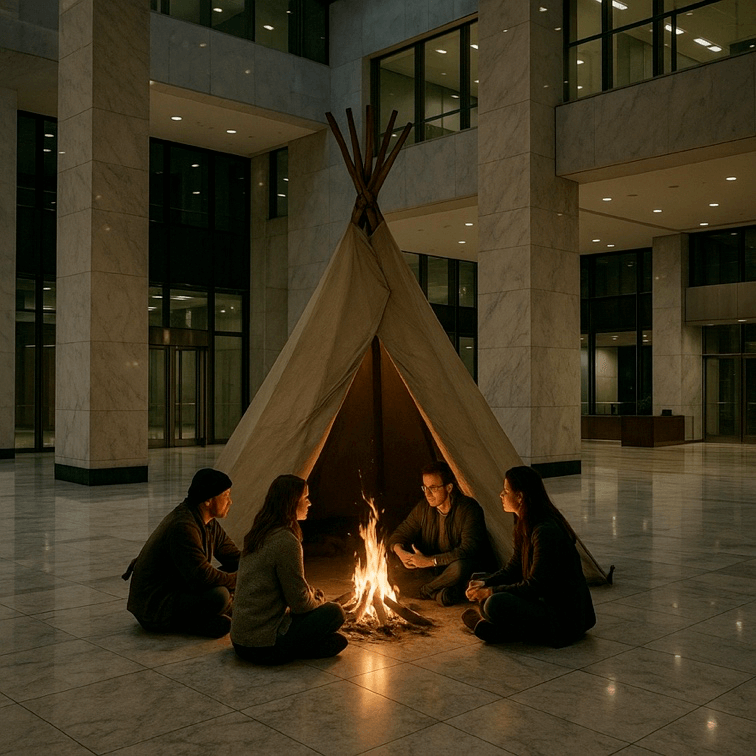
My earliest thoughts about the idea of a leadership field were fairly naïve, not in a negative sense, but in the sense of not yet realizing how rich the literature on field dynamics actually is, especially in organizational contexts. I’ve since gone much deeper into that body of work, but it all began with an image that came to me quite spontaneously while I was waiting in the marble lobby of a large bank.
I pictured the CEO not as someone sitting in a boardroom, but as a kind of Chief, gathering people around an imaginary campfire near a teepee right there in the middle of that polished, gleaming space. Employees would gather around, not just to exchange views, but to connect with one another and with something larger than themselves. Together, they would reflect on the core questions facing the organization, until something like shared wisdom might begin to emerge.
That image became the very first seed of my exploration into what a leadership field might look like in our time.
In that same spirit, I began exploring which other kinds of fields, from everyday life, nature, science, and even from the world of play, curious if they could help deepen the idea of a leadership field. That is why, in this blog, I have gathered a range of different field types to see what kinds of insights they might bring to my quest..
What happens when we place these metaphors side by side? Which underlying principles seem to return again and again? And which of them might also inform how a leadership field takes shape and operates within organizations?
My hope is that this detour through other fields will make the original concept richer, more layered, and perhaps also more practical.
1. Agricultural Field
Characteristics:
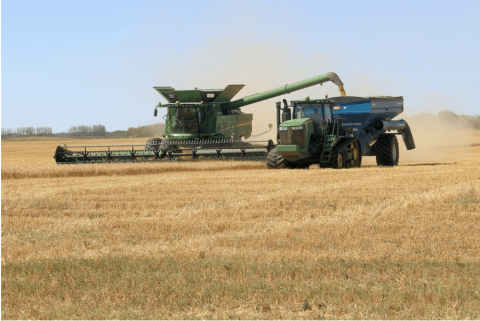
Clearly bounded, cultivated, cyclical (sowing–growing–harvesting–rest). Fertility depends on care, timing, and ongoing attention.
Core principle:
Fertility & rhythm
Leadership Metaphor:
Leadership as cultivation: tending relationships, respecting natural rhythms, allowing periods of rest and not trying to make everything grow at once.

2. Sports Field
Characteristics:
A bounded space with lines, rules, roles, and an audience; shaped by both collaboration and competition.
Core principle:
Boundaries & rules of play
Leadership Metaphor:
Clear boundaries and shared rules create room to play. Without structure, there is chaos; with too many rules, the game freezes. Leadership lies in cultivating the balance between freedom and constraint.

3. Chess Board (64 Fields)
Characteristics:
A structured space governed by a fixed logic; strategic play, anticipating moves, recognizing patterns.
Core principle:
Strategy & pattern awareness
Leadership Metaphor:
Leadership is not only about thinking ahead, but about seeing the game itself and recognizing the patterns beneath individual actions.

4. Electrical Field
Characteristics:
An interplay of charges, currents, and tensions; energy seeks pathways and equilibrium.
Core principle:
Energy & balance
Leadership metaphor:
Energy flows where there is connection; resistance reveals blockages. Leadership becomes the art of managing flow and finding balance between tension and movement.

5. Magnetic Field
Characteristics:
Invisible force lines made visible through the interaction of energy; coherence creates beauty.
Core principle:
Resonance & coherence
Leadership Metaphor:
Inspiration and creativity emerge when energy and intention resonate. Think of those “northern lights” moments in collaboration, when something larger suddenly comes alive.

7. Force Field
Characteristics:
A space in which multiple invisible forces operate simultaneously; sometimes stable, sometimes turbulent. In physics this might be gravity; in organizations it shows up as interests, emotions, and goals that continuously influence one another.
Core principles:
Invisible forces & mutual influence
Leadership Metaphor:
Leadership fields are also force fields of influence, trust, and emotion and these are tangible in their effects, even when they remain unseen.

6. Research Field
Characteristics:
A space for observation, hypothesis, experimentation, and learning; mistakes generate insight.
Core principle:
Curiosity & learning
Leadership Metaphor:
A leadership field as a living laboratory. Learning, reflection, and experimentation keep the field alive and responsive.
8. Battlefield
Characteristics:
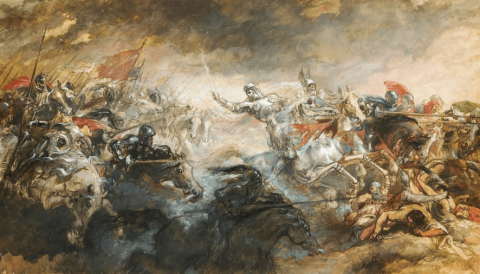
A space of confrontation, strategy, and survival; high pressure, clear front lines, but also chaos and unpredictability; moral and emotional stakes are high.
Core principle:
Conflict & decisiveness
Leadership Metaphor:
A leadership field also includes moments of struggle between interests, values, or competing tempos. At times, the field calls for clarity, courage, and choice. The art is not to avoid conflict, but to transform it into direction and clarity: struggle without destruction.

9. Quantum Field
Characteristics:
Invisible, ever-present, and full of potential; the smallest units of energy interact non-locally; everything is connected, even without direct contact.
Core principle:
Potential & interconnectedness
Leadership Metaphor:
A leadership field often holds unseen possibilities: ideas, talents or insights that can manifest once the right quality of attention is present. Leadership becomes the practice of observing without forcing, allowing potential to become reality. As in the quantum field, observation shapes what appears.
10. Field of Vision
Characteristics:
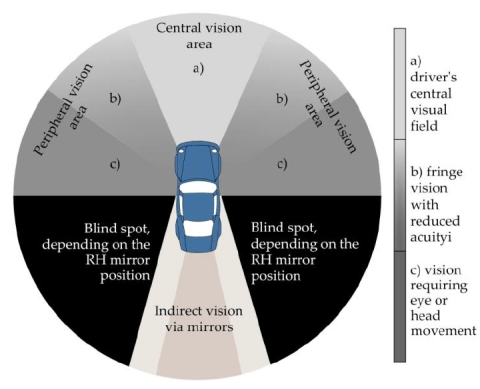
What falls within the range of vision or awareness; sharp at the center, diffuse at the periphery; movement is noticed faster than detail.
Core principle:
Attention & perspective
Leadership Metaphor:
Within a leadership field, the field of attention determines what becomes visible and what remains unnoticed. Leadership requires both focused vision (a clear center) and peripheral awareness (sensitivity to signals at the edges). What lies outside our direct view still influences the whole.
Harvesting these different fields
When we place these ten very different fields side by side, a surprisingly coherent picture begins to emerge. Each field, whether agricultural, energetic, playful, investigative, or conflict-driven, reveals something about the conditions under which life, movement, and meaning can arise. From this collection, I see five recurring themes that help outline the anatomy of a leadership field.
1. Rhythm, cycles, and care
A leadership field thrives on attention and ongoing care. Like an agricultural or research field, it depends on rhythms of sowing, growing, harvesting, and resting. Leadership becomes more robust when there is space for reflection, learning, and regeneration and when not everything has to accelerate at once.
2. Energy, force lines, and resonance
Much of what makes a field strong is invisible: trust, intention, undercurrents, latent potential. These elements shape how energy flows, where resistance emerges, and when resonance becomes possible. Leadership requires sensitivity to both the visible and invisible forces at work in an organization. Here, leadership is not only about acting, but about noticing how the field itself is moving.
3. Frames, perspective, and shared rules of play
As sports and game fields show, real freedom to play only emerges within clear boundaries. A leadership field needs structure that offers direction without becoming rigid. What we place at the center of attention, and what we notice at the periphery, determines which possibilities become visible and which remain unseen.
4. Conflict, tension, and transformation
A field without tension is lifeless; a field that can hold tension is resilient. In every leadership field, interests, values, and tempos collide. The art lies not in avoiding conflict, but in transforming it into clarity, choice, and direction. Tension then becomes not a fault line, but a source of orientation.
5. Values, meaning, and moral orientation
Across all field types, an underlying layer of values and meaning keeps surfacing: the why behind choices, tensions, and energy. Values guide attention (the visual field), shape what is perceived as important or threatening (the battlefield), give direction to resonance (the magnetic field), and influence how we learn, inquire, and weigh options (the research field). They form the moral undercurrent of a leadership field.
Values shape the quality of interaction and decision-making. They offer direction when situations become complex or ambiguous. A leadership field grows stronger when shared values are visible, felt, and open to conversation.
Taken together, these five themes show that a leadership field is far more than the sum of individual qualities. It is a collective dynamic, a space of relationships, energy, and meaning that people co-create and that, in turn, shapes the leadership of the organization as a whole.
My sense is that when we learn to see, feel, and care for how this field actually works, new forms of leadership can emerge within organizations. These forms can in turn express themselves as more value-driven and shared decision-making capacity, enabling us to carry complex challenges more effectively as a collective.